
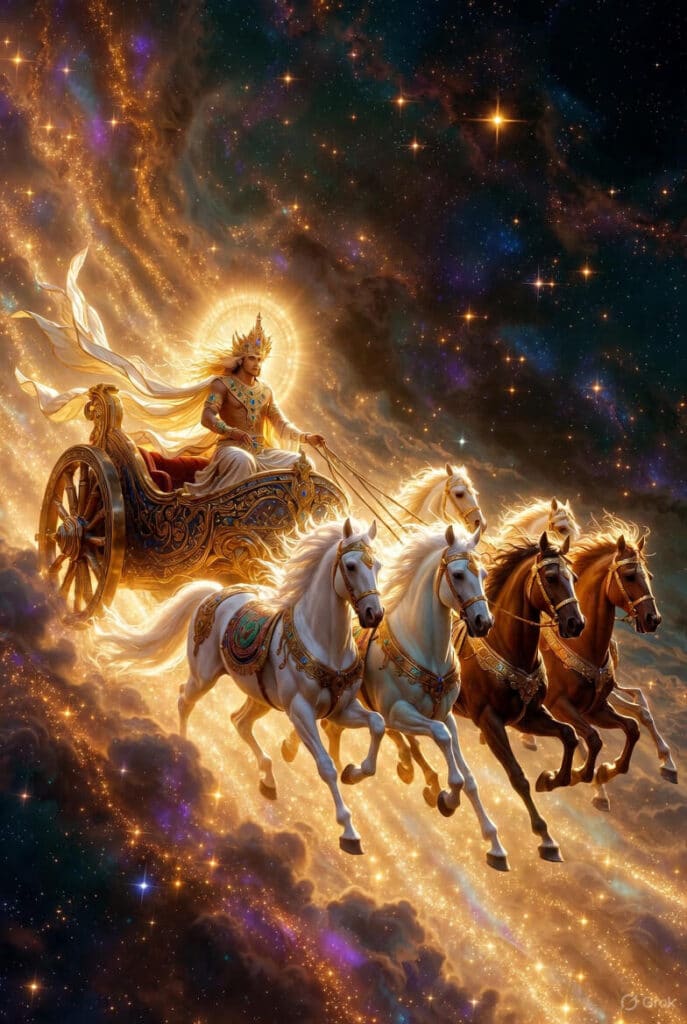
In Sanatan Dharma, Lord Surya, the Sun God, is often depicted riding a majestic chariot drawn by seven divine horses. These seven horses are named Gayatri, Brihati, Ushnih, Jagati, Trishtubha, Anushtubha, and Pankti. Each horse symbolizes different aspects of cosmic and spiritual significance, reflecting the harmony between time, energy, and divine forces that sustain the universe.
The chariot of Surya represents the sun’s steady movement across the sky, symbolizing the cycle of day and night, life and death, and the continuous flow of time. The seven horses are said to correspond to several important concepts:
- They represent the seven days of the week, marking the passage of time in a cosmic sense.
- They symbolize the seven colors of the visible spectrum or rainbow, alluding to the light of the sun being composed of diverse energies.
- Each horse embodies different qualities such as vitality, strength, knowledge, balance, earthly stability, and divine radiance.
The chariot is driven by Aruna, who controls the reins symbolizing the seasons, ensuring the sun’s rays reach all living beings in the right measure and at the right time, sustaining life on Earth.
Symbolically, these seven horses and the chariot illustrate the ordered nature of the cosmos as understood in Vedic philosophy. They emphasize that the universe is a balanced, dynamic system where cosmic energy and light maintain life and spiritual order. The Rigveda and various Puranas mention this imagery, representing both the physical and metaphysical aspects of Surya’s role as the giver of light, time, and life.
Thus, the science of Lord Surya’s seven horses in Sanatan Dharma is not just mythological but also symbolic of cosmic principles—cycles of time, the spectrum of light energy, and the vital forces governing nature and spirituality.
Related